Lifts within a day
The ordinary version. Worth planning around, not worth worrying about.
Three different things get called feeling worse, and they do not mean the same thing or need the same response. Here is how to tell which one you are having.
Which one is yours?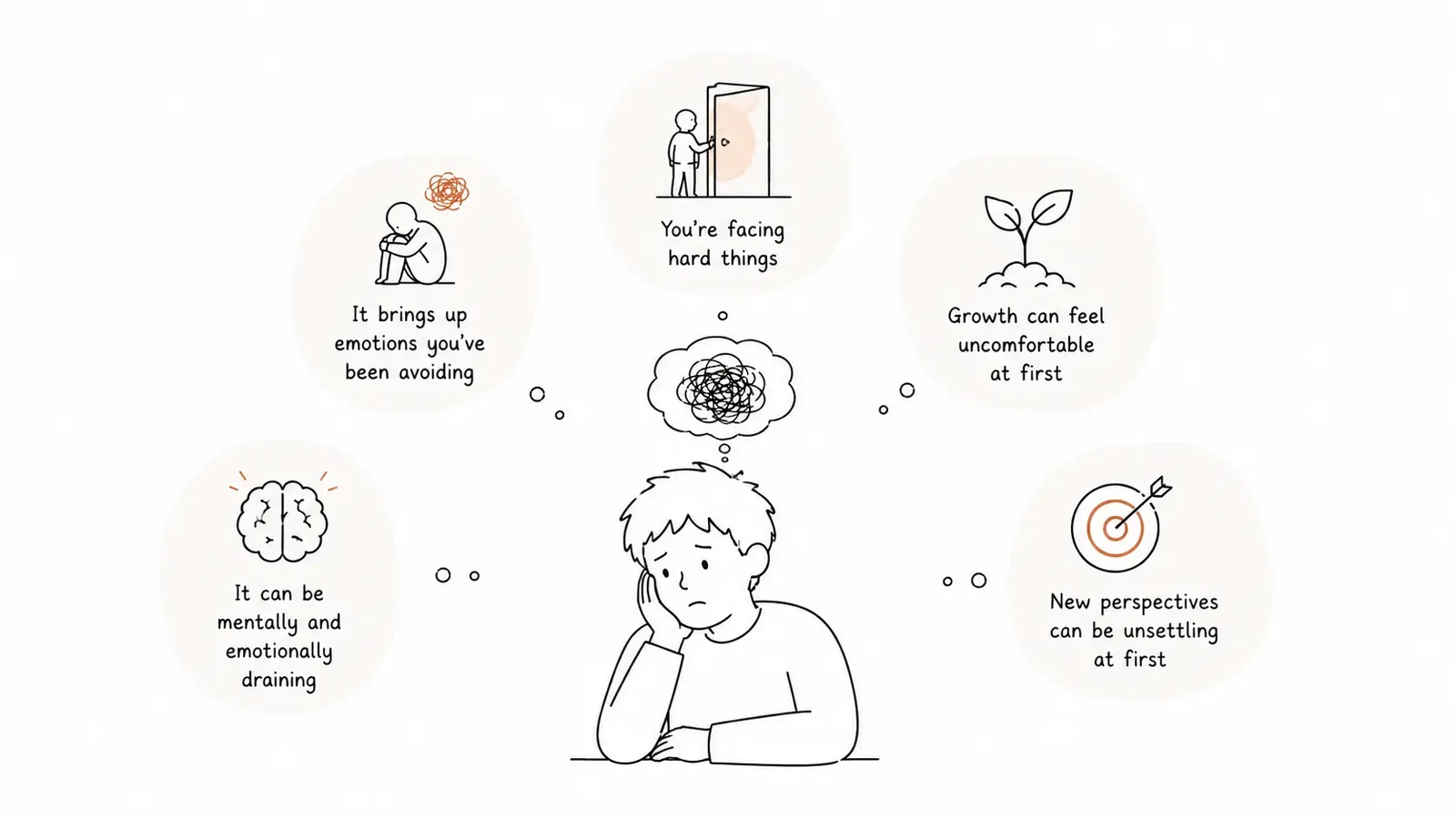
Most of the time, nothing has gone wrong. An hour of concentrated attention on the things you normally steer around is tiring in a way that surprises people, and whatever got opened does not close on schedule because the session ended. That version usually lifts within a day.
But feeling worse is not one thing. It can also mean a session went further than you had support for, which is a pacing problem and fixable once someone says so. Occasionally it means something is genuinely not working. The difference is mostly in the pattern rather than in any single bad evening.
Pick the closest one. Nothing you tap is saved.
The most common one, and the least worrying. Sustained attention on difficult material is genuinely tiring, and an hour of it can leave you as wrung out as something physical. People describe it as a hangover because that is what it feels like.
Treat the rest of the day as smaller than usual. Not a reward, just a lighter load. This kind usually lifts by the next morning.
There is a reason so many people reach for the same word. The hour asks for a kind of attention that most of the week does not: staying with something difficult instead of moving away from it, and doing it out loud in front of someone. That is effortful in a way that does not feel effortful until you stop.
Then the session ends on the clock rather than at a natural stopping point. You walk out mid-thought, and the part of you that was working carries on into the afternoon without the room, the structure, or the other person. Feeling flattened, tearful, or oddly wired for a few hours afterwards is the ordinary shape of that.
This is also why the drive home is such a reliably strange twenty minutes, and why planning something demanding straight after a session tends not to go well.
The second version is a pacing problem. A session goes somewhere you were not braced for, and you leave holding more than you have anywhere to put. That is not a sign the material was wrong. It usually means the approach to it was faster than what you had built up to.
This one matters because it is quietly fixable and almost nobody raises it. How much ground a session covers, how it is ended, whether the last ten minutes are used to come back down rather than to keep going, are all things a therapist can change once they know they need to. Most will, readily. They cannot do it from a session that ended with you saying you were fine.
If saying that out loud is the hard part, that is its own common problem, and the piece on withholding covers why the sentence is heavier than it looks.
One bad evening tells you almost nothing. What it does over weeks tells you most of what you need.
The ordinary version. Worth planning around, not worth worrying about.
A pacing conversation. Bring it as a pattern rather than as one heavy week, because the pattern is the part they cannot see.
Sleep, work, and how you are managing day to day are the measures here, not how any single session felt. A downward trend needs saying out loud.
Writing one line after each session for a month makes this visible in a way memory does not, because your memory of six weeks ago is being edited by how this week went. Keeping a light record between sessions is the same habit doing double duty.
Stop trying to finish it. The instinct is to keep working on the drive home and get it resolved. Whatever was opened does not close faster under pressure, and the attempt usually turns into a loop rather than a conclusion.
Make the rest of the day smaller. Not a treat. Just fewer demands than you would normally accept, in the same way you would after anything else tiring.
Go through the body first if you are wired. When the agitation is physical, analysis is the wrong tool. Paced breathing or a sensory grounding sequence gets further than thinking about it does.
Put it somewhere before the week edits it. Two lines about what came up, written the same day, will be worth a lot more next session than your Thursday summary of it.
Everything above assumes a difficult few hours, not a crisis. If sessions are leaving you unable to keep yourself safe, if thoughts of harming yourself are appearing or intensifying, or if you cannot function in the days afterwards, that is not something to hold until your next slot.
Contact your therapist between sessions, which is something most will tell you is allowed and few clients do. If you cannot reach them and you are not safe, contact local emergency services. In the US you can call or text 988, free and anonymous.
Usually because sustained attention on difficult material is tiring and because something got opened that has not closed again yet. That kind of drop tends to lift within a day. A reliable slide after every session, or a trend that gets worse over weeks, is a different thing and worth raising.
Yes, and it is common enough that many people plan around it by not scheduling anything demanding straight afterwards. Crying after a session is usually a sign the hour reached something rather than a sign it went badly.
Hours to a day or two is the usual range. If it consistently runs longer than that, if it happens after every session without exception, or if your overall functioning is declining across weeks, tell your therapist. Pacing can be changed.
Not automatically, and it is worth being careful with that idea. Feeling worse is compatible with good therapy, but it is not evidence of it. Discomfort that comes with a sense of having got somewhere is different from discomfort that just repeats.
Not necessarily, and expecting to sets you up to read a normal session as a failed one. Relief is common after sessions that resolved something, and so is feeling flat or raw after sessions that opened something. Neither one on its own tells you whether the work is going well.
Raise it before deciding. Pacing, approach, and how sessions end are all adjustable, and most people who feel worse are running into something changeable rather than something wrong. If you have raised it clearly and nothing changed, that is useful information about fit.
sokoon is somewhere to put what came up while it is still close, so it is not sitting on you until Thursday. One full text session every day on Free, no card required. Alongside therapy, not instead of it.
Not therapy or crisis care.