Shame
The obvious one. Shame is specifically the feeling that says do not let anyone see this, and it does not make an exception for the person you are paying to see it.
Almost everyone does it, almost nobody plans to, and it is fixable later than you think. What the withholding costs, and how to say the thing you have been not saying.
Find your version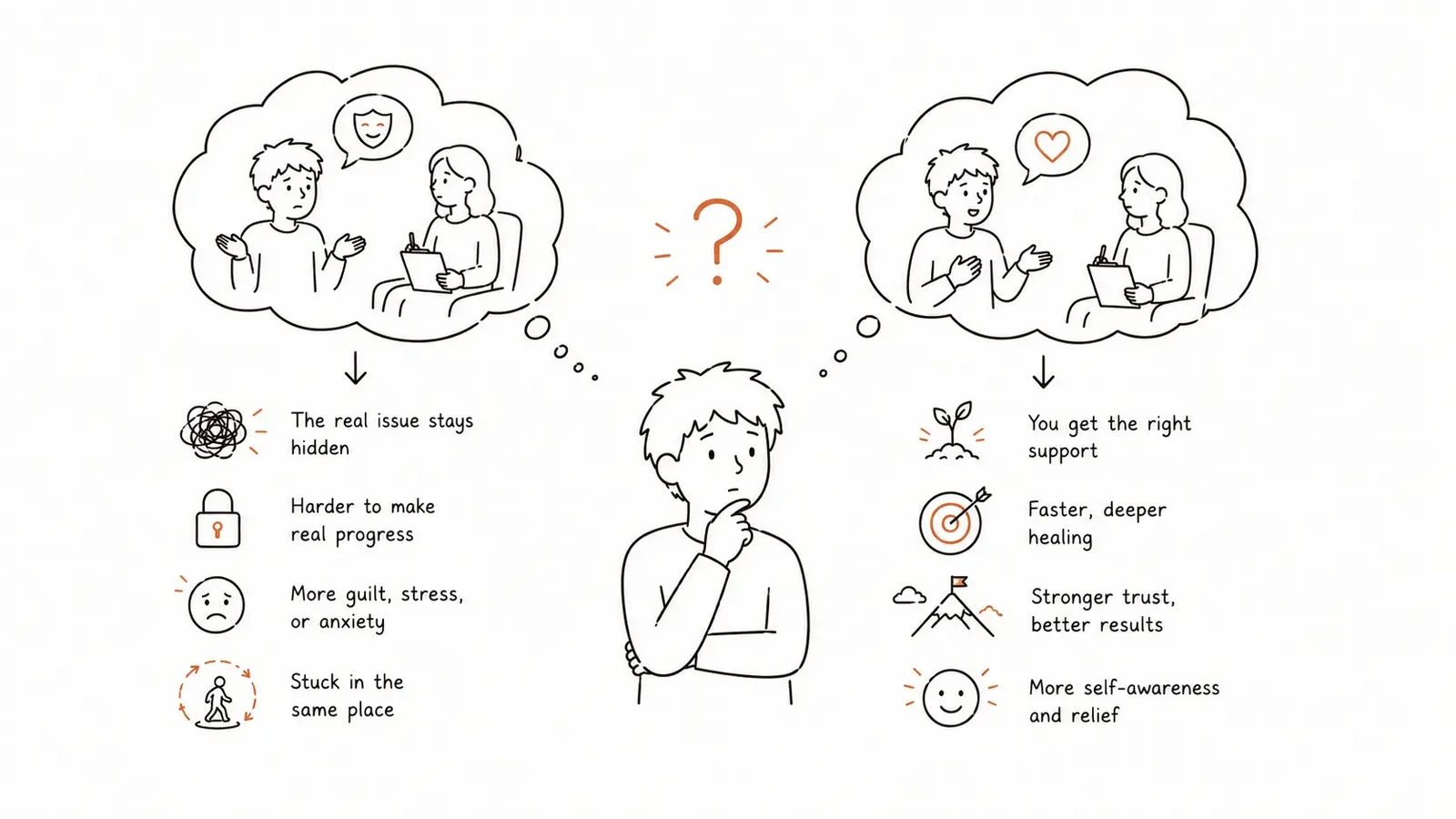
No, you are not a bad client, and no, you have not wasted the money. You are doing the single most predictable thing a therapy client does.
It is worth fixing anyway, though not for the reason you are probably bracing for. Nobody is keeping score of your honesty. The problem is mechanical: a therapist can only work from the picture you hand them, so whatever stays out of the picture stays unhelped, and you keep paying for an hour aimed slightly to the left of the actual thing.
They are not the same, and they do not cost the same. Nothing you tap is saved.
Minimising is the most common version by a distance. It usually is not a decision. You get asked how things have been, the honest answer would take twenty minutes and some crying, and fine arrives before you have chosen it.
Your therapist calibrates everything to the version they hear. A fine week means they aim lower, move slower, and never get near the thing you needed help with.
"When you asked how last week went, I gave you the short version. It was worse than I made it sound."
Common enough that researchers stopped treating it as an anomaly and started studying it as a normal feature of therapy. Work on client dishonesty, including a frequently cited survey published in Counselling Psychology Quarterly, finds that the overwhelming majority of clients say they have been dishonest with a therapist at some point.
The shape of it is consistent too. Most of it is not invention. It is minimising, omitting, and letting a slightly wrong impression stand, which is the same set of things people do everywhere else in their lives when a full answer would cost more than they have that day.
The obvious one. Shame is specifically the feeling that says do not let anyone see this, and it does not make an exception for the person you are paying to see it.
You have a relationship with this person now. They have been on your side. Telling them the thing they suggested did not help feels like taking something away from them.
Some things are not withheld so much as unformed. You cannot hand over something you have not managed to put into a sentence, and the hour moves fast.
You only get fifty minutes. Opening the big thing at minute forty is a bad idea, so you do not open it, and then the same maths applies next week.
The hard part is not the confession. It is the run-up, which gets longer every week you rehearse it. Three things make it shorter.
Say it early in the session. Not at minute forty. If you leave it late you have guaranteed there is no time to deal with it, which is often quietly the point.
Flag it before you explain it. Announcing that something is coming buys you a few seconds and commits you out loud, which is harder to reverse than an intention. There is something I have not been honest about is a complete opening sentence.
Skip the justification. You do not owe an account of why you withheld it before you say what it is. The why is interesting material and it can come second.
If saying it cold is too much, write it first. That is most of what the session prep tool is for, and putting it into words privately is a much smaller step than putting it into words with someone watching your face.
This is missing from most advice on the subject, and it matters. You are allowed privacy. Therapy is not a full disclosure agreement, and there is no obligation to hand over every part of your life because you booked a standing appointment.
Withholding is worth addressing when it is steering the work: when the thing you are not saying is the thing driving what you are saying. It is not worth addressing simply because a detail exists that you would rather keep. Those are different, and confusing them turns therapy into an obligation you start dreading.
It is also fair to ask about the limits of confidentiality directly, and to ask before you disclose rather than after. Every therapist has situations in which they are required to act, they know exactly what those are, and asking is a normal question rather than a suspicious one.
It is extremely common rather than shocking, and it is not a moral failure. The real cost is practical: your therapist can only work with the picture you give them, so the parts you leave out are the parts that go unhelped. You can correct it later, and correcting it late still counts.
Yes. Research on client dishonesty consistently finds that the large majority of therapy clients report having been dishonest with a therapist at least once, most often by minimising how bad things have been rather than by inventing anything.
Sometimes they will sense that something is being steered around, and often they will not. Many therapists notice the shape of an avoidance without knowing its content, and most will leave it alone until you are ready rather than confront it.
Name that you are about to, then say the thing before you talk yourself out of it. Something like: there is something I have not been honest about, and I want to say it now. You do not have to explain why you withheld it before you say what it is.
No. You are allowed privacy and you are allowed to decide something is not for this room. Withholding becomes a problem when it is quietly shaping the work, not when you simply have parts of your life you would rather keep to yourself.
sokoon is somewhere to put the thing into words before you take it into the room. One full text session every day on Free, no card required. It is not a therapist and it does not replace one.
Not therapy or crisis care.