You feel understood, not just heard
What comes back to you is recognisable as what you meant, including the parts you said badly.
The hard part is that good therapy often feels bad, so the obvious signal is the wrong one. Here is what to measure instead, what to raise before you decide anything, and where fit stops being the question.
Start with what you are feeling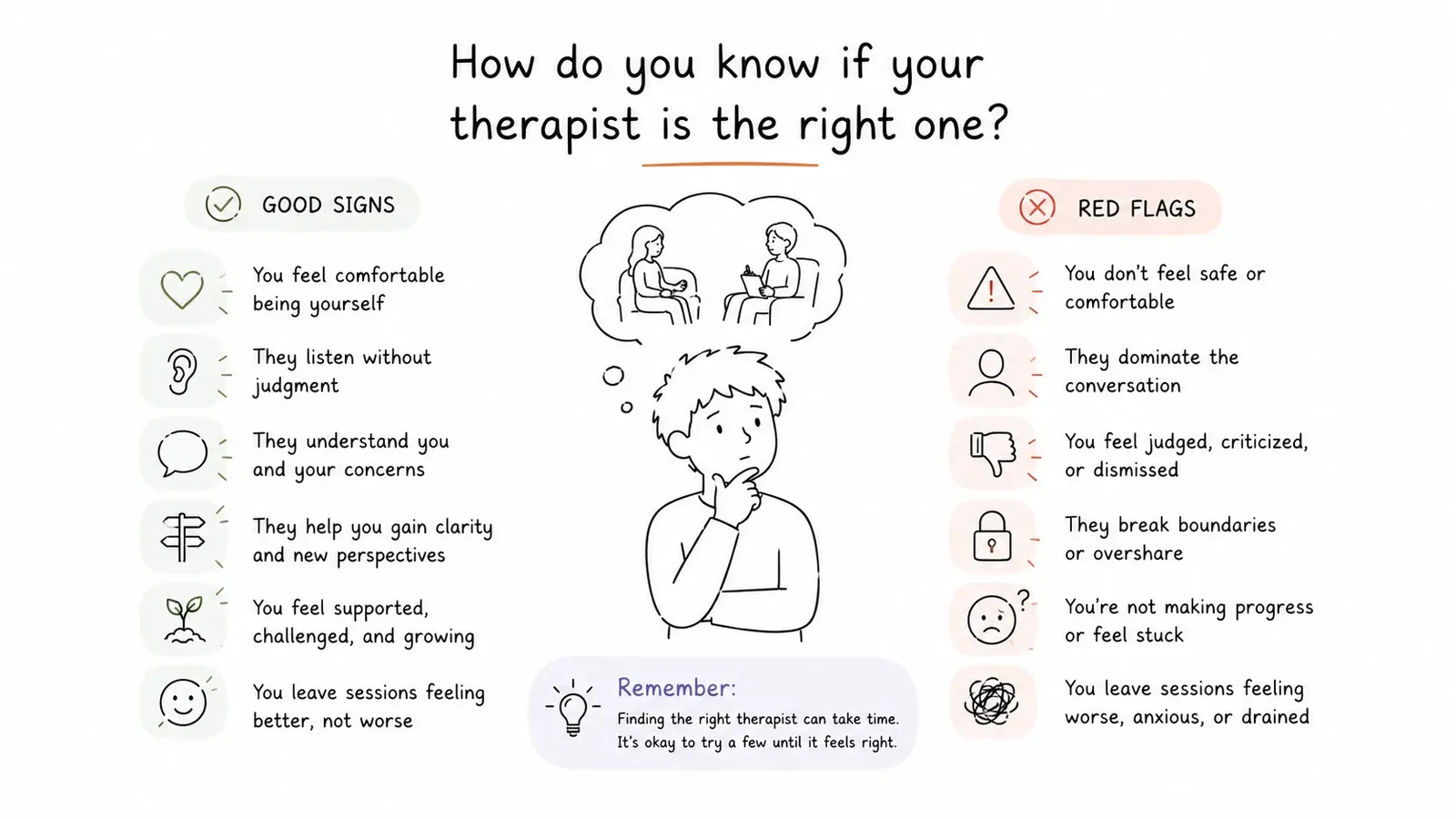
Each of these points somewhere different. Nothing you tap is saved.
Dread on its own is close to useless as a signal, because it points at both possible answers. People dread sessions that are working, for the obvious reason that the session is where the difficult thing gets touched.
Ask what you are dreading. The material, or the hour itself? Dreading the material usually means you are close to something. Dreading the room means something about the room.
Most people judging their therapist are quietly using one measure: how the hour feels. It is the most available data and it is close to the least reliable, because the sessions that do the most tend to be the ones you would rather have skipped.
This cuts the other way too. A therapist you like enormously, who is warm and easy to talk to and never takes you anywhere difficult, can be a genuinely poor fit for what you came in for. Pleasant is not the same as useful, and a session that never costs you anything may not be doing very much.
The distinction that holds up is between uncomfortable and unheard. Being taken somewhere you have avoided is uncomfortable and is usually the work. Explaining yourself for the fourth week running to someone aiming at a different problem is not a phase, and waiting it out does not resolve it.
Five things worth watching over a few sessions rather than judging in one.
What comes back to you is recognisable as what you meant, including the parts you said badly.
Not a solution every week. A thought you did not walk in with, or a thing to notice before next time.
When an approach is not landing, they try another one and can tell you why they are trying it.
Sessions start and end when they should, cancellations are rare, and the hour stays about you.
You could say they had got something wrong, or that you do not want to go into something, without bracing.
The ten-question fit check runs through these one at a time and gives you back the two worth raising first.
A large share of the fit problems people quietly leave over are the kind that get fixed by being named. They do not get named because saying it feels like a complaint against someone who has been kind to you, so people go and find a new therapist instead and sometimes meet the same problem there.
Keep it early in the session and specific to what has happened. Any of these are complete openings on their own:
Then watch what they do with it. That response is the measurement. A therapist who asks what you mean, takes it seriously, and changes something has told you what you were trying to find out. One who becomes defensive, or reframes your raising it as resistance, has also told you.
If saying it cold is too much, write it first. The session prep tool exists for exactly this, and the piece on withholding covers why the sentence is so much harder than it looks.
Some things are not preferences and do not belong on a spectrum with the rest. A therapist pursuing a personal or romantic relationship with you. Sharing your information outside the limits they explained. Asking you for money or favours beyond the fee. Bringing you their own problems until you are the one doing the looking after. Treating your identity or culture as a thing to be corrected.
None of these are worked on by trying harder in the room, and none of them are outweighed by everything else having been good. Therapists are registered with professional bodies that publish how to raise a concern, and talking it through with someone outside the situation first is a reasonable step rather than an escalation.
End it in the room rather than by going quiet. Disappearing is the most common way therapy ends and it is the one that leaves you with the least, partly because leaving badly is often a rehearsal of something you came in to work on.
One session to say it is enough. What you get out of that session, whether it is a clearer sense of what you need next or just the experience of ending something cleanly, tends to be worth more than the hour cost. And it is not a referendum on therapy itself. Fit varies, people change, and needing someone different now says very little about whether this was right before.
The useful tests are whether you feel understood, whether you leave with something, whether they change approach when something is not working, whether the frame is reliable, and whether you could disagree with them out loud. Comfort is not one of the tests.
Yes, and it is not a comment on either of you. Fit is a real variable in therapy outcomes, which is why most therapists are entirely used to people moving on and do not take it personally.
Three or four sessions is a reasonable window for judging whether you can talk to this person, and longer before judging results. If something feels wrong in the first session in a way you can name, that is worth raising immediately rather than waiting out an arbitrary number of weeks.
Say it in a session rather than by disappearing, and ideally with one session left to talk about it. Ending well is genuinely useful, and a therapist who reacts badly to being told has answered a question you were already asking.
No. The one thing worth doing first is naming the problem to the therapist you have, because a large share of fit problems that people leave over turn out to be fixable by saying them out loud.
sokoon is somewhere to think it through before the conversation, so you walk in with a sentence rather than a feeling. One full text session every day on Free, no card required. Alongside therapy, not instead of it.
Not therapy or crisis care.