How to Stop Ruminating (When You Keep Replaying the Same Thoughts)
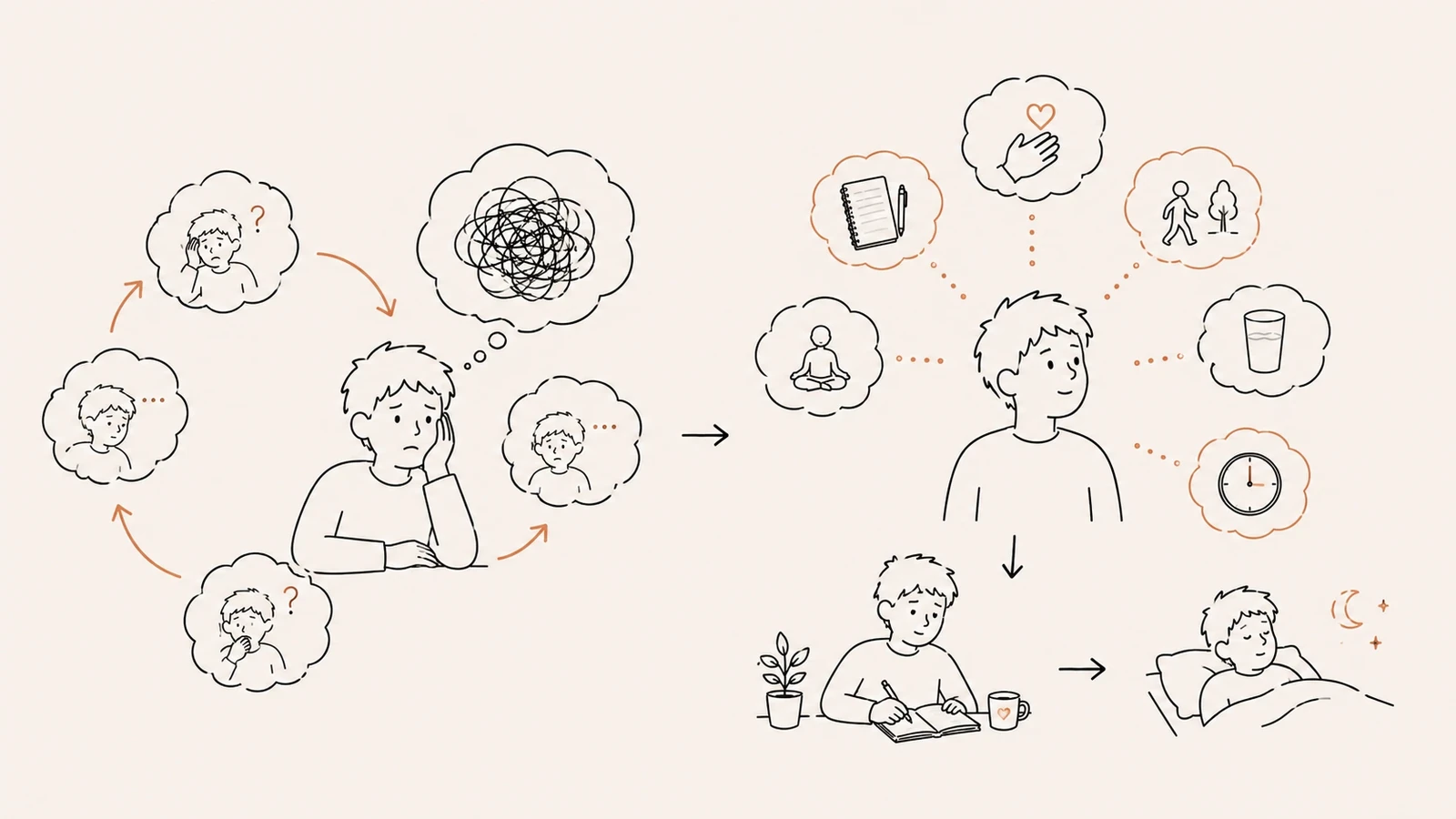
You go over the same conversation for the tenth time. The thing you said that landed wrong. The decision you are not sure about. The worry that has no answer. You are not getting anywhere, and you know you are not getting anywhere, but you cannot seem to put it down. That looping is called rumination, and here is why it happens and how to step out of it.
Overthinking versus rumination: what is the difference?
Working a problem out has a direction. You weigh things, you reach some kind of conclusion, and you come away with a sense of what to do or at least where you stand. Rumination has no direction. You circle the same ground without ever landing, picking the thing up, turning it over, and putting it down exactly where you found it. The difference matters, because rumination feels like problem solving from the inside. That is the trap. You feel like you are working on it, so you keep going, but the loop has no exit built into it.
| Pattern | Usual direction | What changes as you think? |
|---|---|---|
| Problem solving | Toward a decision or action | You gain information, narrow options, or choose a next step. |
| Overthinking | Past, present, or future | You keep adding possibilities without getting closer to a decision. |
| Rumination | Often past events or current distress | The same meaning, regret, or self-judgment repeats. |
Researchers use several definitions, but a broad review of rumination and repetitive thought makes one distinction especially useful: repetition is not automatically harmful. Its direction, emotional context, and whether it produces anything new all matter.
Why your brain keeps doing it
Part of it is that your brain mistakes repetition for progress. Going over something again feels like you are being careful, or making sure you do not get caught out, or keeping a painful thing from happening twice. There is a kind of logic to it, even though it does not actually protect you from anything.
Rumination also tends to lean in a direction depending on what is underneath it. When it is pointed at the future and all the ways things could go wrong, it usually has anxiety and catastrophic predictions behind it. When it is pointed at the past, at regrets and things you cannot change, it often travels with low mood. Either way, the loop feeds the feeling and the feeling feeds the loop.
Rumination feels like you are working toward an answer. Most of the time it is a tape on repeat. The way out is rarely to think harder. It is to notice you are in the loop and deliberately do something else.
Why you keep replaying a conversation
A conversation is an ideal object for rumination because it is finished but still feels editable. You can change your wording in your head, imagine a different response, or search someone’s face and tone for a certainty that was never available in the moment.
Replaying becomes useful only when something changes. Ask yourself:
- What do I know happened? Keep this to observable facts.
- What am I assuming? Name the mind-reading or prediction directly.
- Is repair possible? Decide whether an apology, clarification, or boundary would help.
- If no action is possible, what am I hoping one more replay will give me?
If your answers are unchanged after another pass, the loop is no longer gathering information. It is repeating distress.
What actually helps
Start by catching it. Simply naming what is happening, telling yourself "I am ruminating," puts a small gap between you and the thoughts. You cannot interrupt a loop you have not noticed you are in.
Then ask one question: is there something here I can actually do? If there is a real next step, take it, even a tiny one, and you have turned circling into action. If there is no step, that is your signal that more thinking will not help, because the problem is not the kind that gets solved by going over it again.
Changing what you are doing physically breaks the loop more reliably than trying to think your way out. Rumination thrives when you are still and unoccupied, so getting up, moving, or doing something that needs a bit of attention starves it. It also helps to be kind to yourself about it. Getting frustrated that you are ruminating just adds a second loop on top of the first.
A blank page can help when it gives the thought structure rather than more room to roam. Try one of our journal prompts for overthinking and repeated conversations. If the loop is one thought rather than a general fog, a CBT thought record is the more structured version: you write the thought out, gather what supports it, then gather what does not. If you would rather talk it through, sokoon’s overthinking text sessions are built around putting one recurring thought into words and considering what comes next.
When it is worth taking seriously
Everyone loops sometimes. If it is most days, if it is keeping you up or pulling you out of your life, or if it has been going on for weeks, that is worth paying attention to. Persistent rumination is closely tied to both anxiety and depression, and it tends to ease with approaches that work on the patterns driving it rather than the content of any single worry.
A recent meta-analysis found that cognitive behavioral interventions (CBT) had a moderate overall effect on repetitive negative thinking, with approaches designed specifically for rumination and worry performing better than more general approaches. You can read the full review. A self-help page can explain the pattern; persistent or severe symptoms deserve a licensed professional who can assess the whole picture.
It is easier to step out of the loop with a little help.
sokoon offers a free daily text session to untangle what you keep replaying and figure out what, if anything, it is actually asking you to do.