Signs You Might Be Struggling With Anxiety (and What to Do)
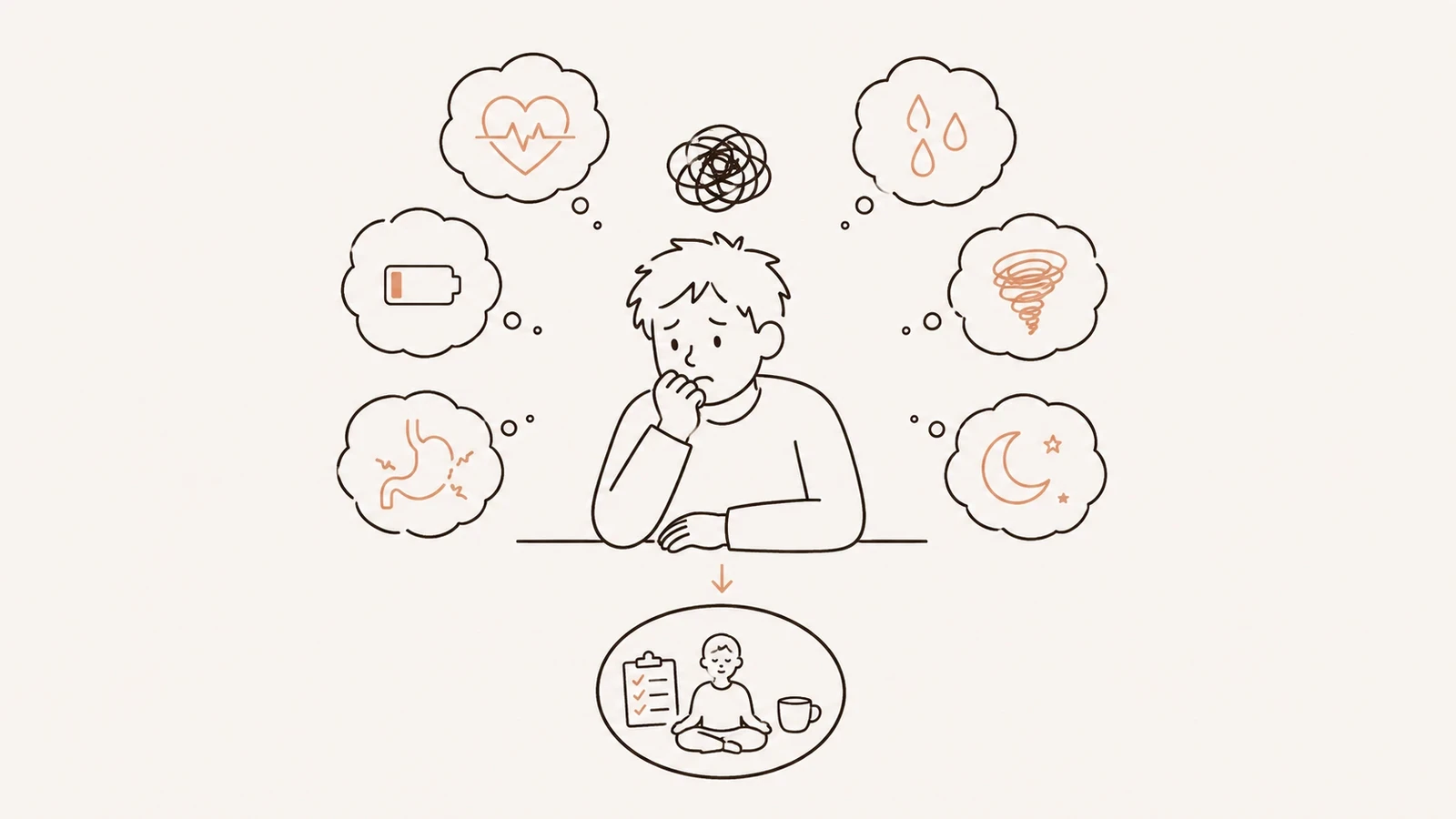
Anxiety does not always look the way people expect. It is not always panic attacks and visible distress. A lot of the time it is quieter than that, and easier to miss or explain away as something else. Here is what anxiety actually looks like across its different forms, and what tends to help.
The signs that are easy to miss
Avoidance is one of the most common signs of anxiety, and one of the least obvious. You stop going to the places or doing the things that make you feel unsafe or uncomfortable. This can look like skipping social events, putting off tasks indefinitely, finding reasons not to do things you used to enjoy. From the outside it can look like laziness or apathy. From the inside it often feels like relief, at least temporarily.
Irritability is another one that gets misread. When your nervous system is running hot all the time, small things hit harder. You snap at people. You feel easily overwhelmed by things that would normally not bother you. This is often more visible to the people around you than to yourself, and it can look a lot like a mood problem rather than an anxiety problem.
Physical symptoms are also common and often not connected to anxiety by the person experiencing them. Headaches that keep coming back. Stomach issues with no clear cause. Trouble sleeping, or sleeping too much. Tension in your jaw or shoulders. These are real physical responses to chronic low-level stress, not imagined, not separate from what is happening emotionally.
The thinking patterns that show up
Anxious thinking has some consistent patterns. One of the most common is worst-case scenario thinking. Your mind automatically jumps to the worst possible outcome of a situation and then dwells there, running through the scenario in detail, building the fear while you are still just imagining it.
Another is reassurance-seeking. You feel anxious about something so you ask someone to tell you it will be okay, and it helps briefly, then the anxiety comes back and you need to ask again. This pattern can be exhausting for the people around you, and it does not actually reduce the anxiety long-term because you never build your own confidence that you could handle the thing.
Rumination is the version that happens at night. You replay past conversations, past events, things you said or did not say. You think about what you should have done differently. You go over it again and again without reaching any resolution, because rumination is not problem-solving. It is just rehearsing worry.
The thing about all of these patterns is that they feel like they are helping. Checking feels safer than not checking. Avoiding feels better than the discomfort of facing something. The relief is real, it just does not last, and it tends to make the anxiety stronger over time.
Anxiety versus stress: what is the difference
Stress is a response to something real and present. You have an exam tomorrow, you are stressed. The exam passes and the stress reduces. Anxiety hangs around even when there is nothing immediately pressing. It attaches to things that have not happened yet, or to things that happened in the past, or to nothing specific at all. It is persistent in a way that stress is not.
That distinction matters because the interventions are different. Stress often responds to practical solutions, time management, preparation, rest. Anxiety responds better to approaches that address the thinking patterns underneath it, which is where frameworks like CBT are specifically useful.
If you are not sure which one you are dealing with, a useful question is: does this feeling go away when the triggering situation is resolved? If yes, it is probably mostly stress. If the feeling persists or just attaches to the next thing, that pattern is worth paying more attention to.
What actually helps
The evidence for CBT in treating anxiety is some of the strongest in the field. The core of it is learning to examine the thoughts driving the anxiety rather than just experiencing them. What are you actually predicting will happen? What is the evidence for and against it? What would you tell a friend who was thinking the same thing? These questions do not eliminate anxiety, but they change your relationship to it. That structured reflection is why we built sokoon's AI support for anxiety.
Gradual exposure is the other major piece. Avoidance maintains anxiety. Facing things in small, manageable steps reduces it over time, because you accumulate actual evidence that you can handle the things you were afraid of. This is uncomfortable in the short term and genuinely effective in the longer term.
For immediate moments of high anxiety, grounding techniques like 5-4-3-2-1 are useful because they interrupt the thought spiral. Focusing on what you can physically sense right now, what you can see, hear, touch, brings your attention back to the present rather than the imagined future where the anxiety lives.
When to talk to someone
If anxiety is consistently getting in the way of things you want to do, or if it has been present for more than a few weeks with no clear trigger, that is worth taking seriously. If you want an objective baseline, taking a free 2-minute GAD-7 anxiety check can help put what you are experiencing into clearer context.
Talking to someone does not have to mean a formal appointment or a long-term commitment. It can start with something much smaller. A GP. A counselor. Someone you trust. A platform where you can work through what you are feeling without judgment and without it being a big deal. The point is just to not leave it entirely alone.
You do not have to keep sitting with it alone.
sokoon gives you a private space to work through what you are feeling, at your own pace, without judgment.