Best AI Mental Health Apps 2027
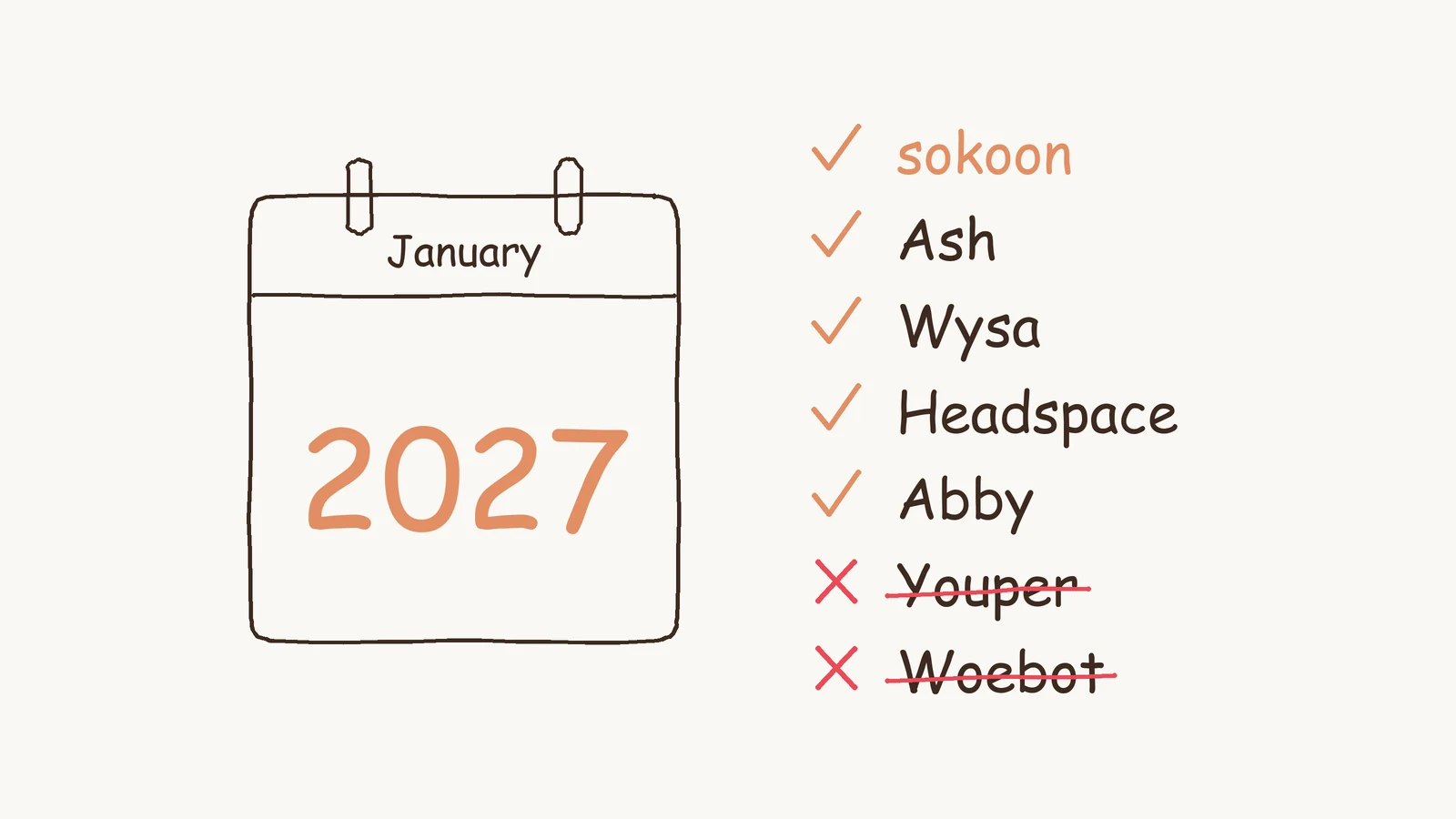
sokoon wrote this list, and sokoon is on it. Keep that in mind. To make up for it, we checked every other app against its own pages, store listings and privacy policy on November 29, 2026, and we say plainly where each one does something better than we do.
A lot moved this year. Youper shut down. Ash left the UK. Earkick was bought by another company. More states passed laws about what an AI is allowed to call therapy. So this is less a ranking than a map of what is still standing going into 2027, and who each app actually suits.
The short version
- Want a daily conversation that picks up where you left off, free every day? Try sokoon.
- Find it easier to talk than type, and live in the US? Try Ash.
- Want exercises and structure more than open conversation? Try Wysa.
- Already use Headspace for sleep or meditation? Ebb is already in your subscription.
- Want to try a voice companion in your browser before paying? Try Abby, but the free part is short.
What changed going into 2027
Two apps that used to top these lists are gone. Youper discontinued its services on September 30, 2026. Woebot closed its consumer app on June 30, 2025, and its founder told STAT that the cost and difficulty of getting FDA authorization was the main reason. Plenty of lists published this year still recommend both. If a list sends you to an app that no longer exists, it probably did not check much else either.
Slingshot AI pulled Ash out of the UK in January 2026 over medical device rules. Earkick was acquired by Elomia Health in November 2026. Headspace gave its companion, Ebb, a voice mode and longer memory in December 2025. And Talkspace, best known for human therapy, launched a paid AI agent called Tee in June 2026.
The five apps side by side
The order follows the sections below. It is not a score, and it says nothing about which app helps people more, because nobody has tested that.
| App | Best for | What free gets you | Paid (US) | Voice |
|---|---|---|---|---|
| sokoon | A daily conversation that remembers you | One full text session a day, no card | Basic $9.99/month | Premium ($14.99/month) |
| Ash | Talking out loud (US) | Free download; allowance not published | In-app plans; App Store lists Ash Plus at $19.99 | Yes |
| Wysa | Structured exercises | AI conversation, per its FAQ | Premium; App Store prices start at $74.99/year | Not documented |
| Headspace (Ebb) | People who already meditate | Free trial only | $12.99/month or $69.99/year | Yes, since Dec 2025 |
| Abby | Trying voice or text on the web | Your first conversation | $19.99/month, 7-day trial | Yes, paid |
Checked November 29, 2026 against official pages and US App Store listings. App Store listings show every price a developer has offered, promotions included, so confirm the price inside the app before you pay.
How we picked and checked
We started with the apps that show up most often on 2026 roundups, then dropped the ones that have closed or are not built for mental health. For each of the five left, we looked at the same things: what you get for free, whether you can talk or only type, what it says about memory, how it uses your conversations, and who it says it is not for.
This is a review of what each company publishes. We did not buy competitor plans, run test conversations or test how any app handles a crisis. No clinician reviewed this article. When an app does not publish something, we say so instead of guessing.
1. sokoon: a daily conversation that remembers you
sokoon is an AI you talk to in your browser. It carries context from one session to the next, and every plan includes exercises, Mood Radar and Mind Map. The free plan is one full text session every day, with no card and no end date. Basic ($9.99 a month, or $69.99 a year) adds unlimited text, every AI character and better memory. Premium ($14.99 a month, or $99.99 a year) adds voice.
Where it falls short: the free plan is text only, and you need an account. There are no human coaches or therapists inside sokoon. We have not published a clinical trial, and nobody independent has compared our memory with the other apps here. sokoon is for adults 18 and over.
On privacy, our privacy policy says sessions are stored encrypted, your data is never sold or used for advertising, and your conversations are not used to train our AI. You can ask us to delete your data and account completely.
2. Ash: for when talking is easier than typing
Ash comes from Slingshot AI, which has raised $93 million. You can call it like a phone call or text it. Its App Store listing says it remembers what you say and builds weekly insights from your conversations, and it holds a 4.8 rating from about 7,000 ratings. If speaking out loud is how you sort your head out, Ash is the app on this list built most directly around that.
The catch: Ash launched free in July 2025 but now sells paid plans in the app, and it does not publish a price page or say what the free version includes. It is no longer offered in the UK. Its first outcome study, from November 2025, was run by the company without a control group and has not been peer reviewed. Ash is for adults and says it is not designed for crisis situations.
Its privacy policy (updated August 19, 2026) says your transcripts are used for training only if you opt in, and it offers deletion controls. It also shares some data with analytics and attribution providers. See our sokoon vs Ash comparison for more.
3. Wysa: structure and exercises
Wysa mixes a chat with self-help techniques drawn from CBT and DBT, plus meditation and an exercise library. Its FAQ says the AI conversation is free and the wider library is paid, and human coaching costs extra. It has the longest research record of anything here, though most of those studies looked at older, rules-based versions and many were co-authored by the company. In 2022 it received an FDA Breakthrough Device designation for a chronic pain tool. That designation speeds up review. It is not FDA clearance.
The downside is that Wysa steers you toward exercises. Some people find that reassuring. Others who want to talk something through at length find it tight. The consumer app does not document voice or memory across sessions, and its App Store listing shows prices that contradict each other, from $74.99 to $99.99 a year for Premium.
On privacy, Mozilla gave Wysa a "Best Of" rating in 2023, and Wysa lets you use a nickname. Its policy also says it uses de-identified conversations to train its AI, and a nickname is not the same as being anonymous. See sokoon vs Wysa.
4. Headspace's Ebb: for people who already meditate
Ebb is the AI companion inside the Headspace app. In December 2025 it gained a voice mode and "Enhanced Memory," which recalls details from earlier chats and checks in after hard weeks. It uses motivational interviewing and points you to Headspace meditations and sleep content. If you already open Headspace most nights, Ebb costs you nothing extra.
What you give up: there is no ongoing free version. After the trial, Headspace costs $12.99 a month or $69.99 a year. Ebb is for adults in the US, UK, Canada and Australia, in English only. Headspace says Ebb is not a replacement for therapy, and it said it would publish validation studies in 2026. We could not find them.
5. Abby: voice or text in your browser
Abby runs on the web, iOS and Android. You can talk or type, and after 50 messages it offers a summary and reflection plan. Your first conversation is free, and it will match you with a licensed therapist for free if you want one. The subscription, $19.99 a month with a 7-day trial, adds unlimited conversations and memory of your story.
The free part runs out fast, though. Abby has only 194 ratings on the App Store and no peer-reviewed studies. When we checked its privacy policy in September 2026, it allowed training on anonymized and aggregated conversations. Abby also publishes its own "best AI therapy apps" lists. So do we, which is why every claim here links to a source. See sokoon vs Abby.
Others you will see on 2027 lists
- Earkick pairs mood tracking with a panda companion. Its new owner, Elomia Health, is moving toward selling AI to care organizations and has not said what happens to the consumer app. Think twice before paying for a year.
- Rosebud is an AI journal rather than a chat companion. It suits people who think best in writing. Its plans changed during 2026, so check the current pricing page before you start.
- Talkspace Tee is new and sold separately from Talkspace therapy. We could not load the full announcement, so check what it includes and costs yourself.
- Replika is an AI companion, not a mental health app. Italy's privacy regulator fined its maker €5 million in 2025.
- ChatGPT and other general assistants are free and good at a lot of things. Read using ChatGPT for mental health before you rely on one for this.
What the research says now
The strongest single trial is still Dartmouth's Therabot study (NEJM AI, March 2025). It followed 210 adults, and people who used the bot for four weeks saw bigger drops in depression and anxiety symptoms than people on a waitlist. But clinicians read every conversation and stepped in 15 times for suicidal thoughts, and Therabot is still not available to the public.
Two larger reviews came out since. One in npj Digital Medicine (March 2026) pooled 39 trials and found small improvements in depression and anxiety. One in JMIR (December 2025) looked only at generative AI chatbots. None of its 14 trials had a low risk of bias, and very few checked whether the benefit lasted.
The risks are better documented. In a 2025 Stanford study, chatbots answered appropriately less than 60% of the time, compared with 93% for human therapists. One listed tall bridges to a user who had just said they lost their job. The American Psychological Association said in November 2025 that these tools can support care but should not replace it.
Put together, the research says these apps can help some people feel a bit better in the short term, especially with low mood. That is worth something. It is not treatment, and we found no published randomized trial of the current version of any of the five apps above.
The rules got stricter
Illinois, Nevada and, in 2026, Maine bar AI from providing therapy unless a licensed professional is involved. Utah requires mental health chatbots to say they are AI and limits selling user data. California and New York require companion chatbots to disclose that they are AI and follow self-harm protocols. More states, including Tennessee, Oregon and Washington, passed similar laws in 2026, many taking effect in 2027. The AI Laws by State tracker keeps a running list.
For you, this is why most apps now describe themselves as "support," a "companion" or "wellbeing" rather than therapy. It also means a good app should tell you clearly what it is and point you to crisis help. Our explainer on whether AI therapy is legal goes further.
Five questions to ask before you share anything
- Does HIPAA apply? Usually not. According to HHS, an app you download yourself is normally outside it.
- Is my conversation used for training? Look for whether that is on by default or something you opt into.
- Is anything shared for advertising? BetterHelp paid $7.8 million after the FTC found it shared health data with ad platforms.
- Can I delete everything? Check what the app keeps after you ask, and for how long.
- Who else sees my words? Many apps send text to outside AI model providers and analytics tools. A good policy names them.
In Mozilla's 2023 review, 59% of popular mental health apps earned its privacy warning label. Our guide to AI therapy privacy walks through each question.
When an app is the wrong tool
If you are thinking about harming yourself, call or text 988 in the US, or your local emergency number. For diagnosis, medication, trauma or symptoms like hearing voices, you need a qualified human, not an app. Our two-minute fit quiz can help you think it through. It is not a diagnosis.
Most apps here are for adults, but teenagers use them anyway. A 2026 JAMA Pediatrics study found that about 1 in 5 young people aged 12 to 21 had used a chatbot for mental health advice, and most of them told no one. If you are a parent, ask.
Common questions
What is the best AI mental health app for 2027?
It depends on what you want from it. sokoon suits a daily conversation that remembers context, with one free text session every day. Ash suits people in the US who would rather talk than type. Wysa suits people who want structured exercises. Ebb makes sense if you already pay for Headspace. Abby lets you try voice or text on the web. sokoon publishes this guide, so weigh our pick with that in mind.
Which AI mental health apps are free?
sokoon gives you one full text session every day with no card. Wysa says its AI conversation is free, with a paid library on top. Abby gives you your first conversation free. Ash is a free download but sells paid plans and does not publish what the free version includes. Headspace's Ebb comes with a Headspace subscription, so you only get it free during a trial.
Are Youper and Woebot still available?
No. Youper discontinued its services on September 30, 2026. Woebot closed its consumer app on June 30, 2025. Some 2026 roundups still recommend both, so check that an app exists before you sign up through a list.
Do AI mental health apps actually work?
Reviews of randomized trials published in 2025 and 2026 found small short-term improvements in depression and anxiety symptoms. Most trials were short, many had a high risk of bias, and few checked whether the benefit lasted. Treat these apps as support between other things in your life, not as treatment.
Is my data protected by HIPAA in these apps?
Usually not. HIPAA covers health plans, providers and the companies working for them. An app you download yourself is normally outside it, so the app's own privacy policy and your state's consumer health laws are what protect you.
Try sokoon free, every day
sokoon's free plan includes one full text session every day. No credit card required. An account is required; voice is part of Premium.