How to Calm Down During a Panic Attack (Step by Step)
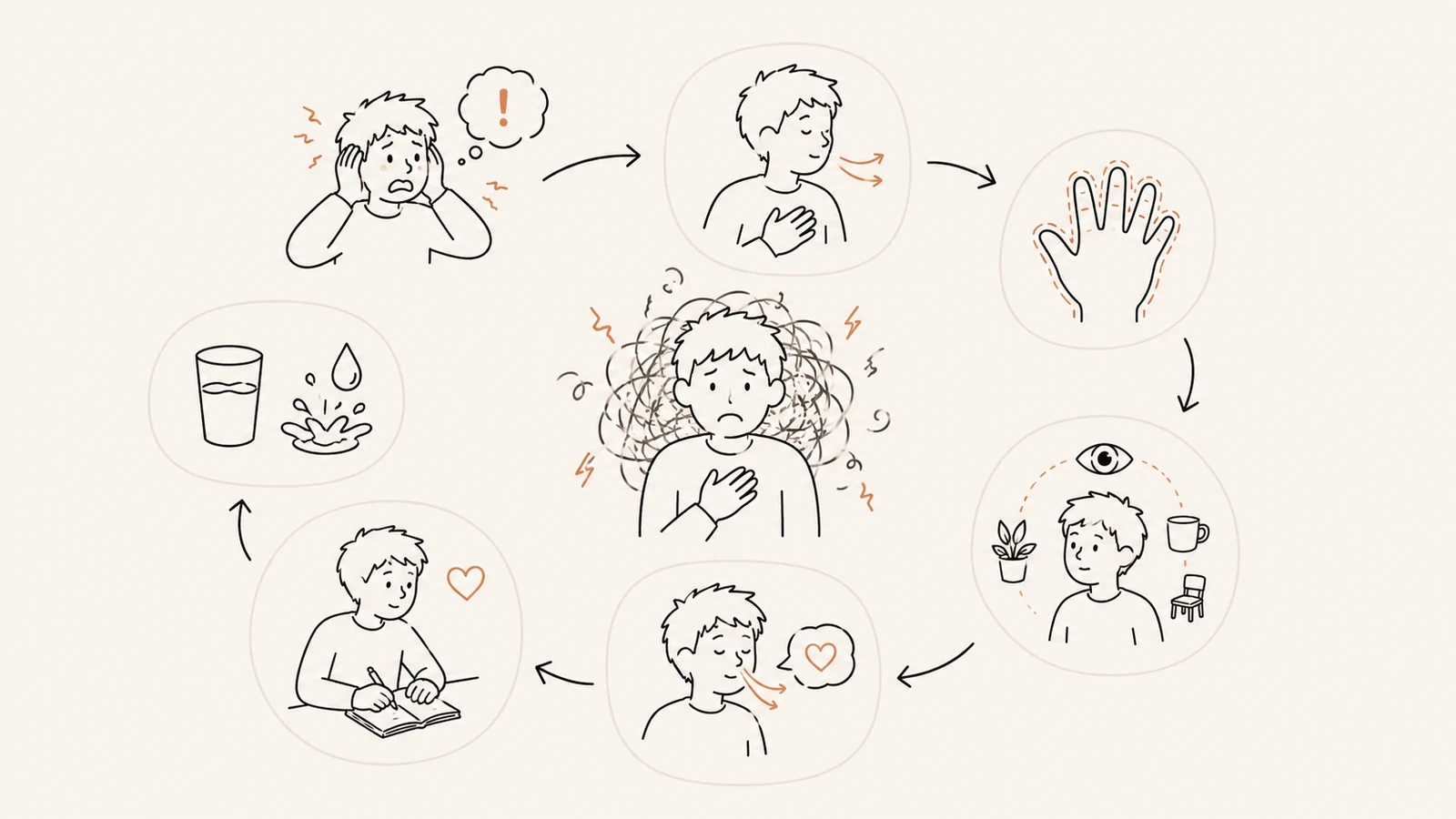
A panic attack can make your body feel as if something is seriously wrong: a racing heart, tight chest, dizziness, shaking, nausea, or a sudden fear of losing control. If this is a familiar panic pattern, the steps below can help you meet the moment without adding more fear. If the symptoms are new, severe, or different from what you have experienced before, do not assume they are panic.
Seek urgent medical help for new or severe chest pain, fainting, serious difficulty breathing, symptoms following an injury or substance use, or anything that makes you think you may be having a medical emergency.
If this feels like a familiar panic attack, start here
You do not need to complete every step. Pick the one that feels possible, stay where you are if the place is safe, and let the next minute be smaller than the whole experience.
1. Name the pattern without arguing with it. Try: “This feels like panic. I have felt this pattern before. I can take the next minute one step at a time.” The aim is not to prove that every sensation is harmless. It is to stop treating each sensation as fresh evidence that the fear is escalating.
2. Let your breathing become slower and gentler. Panic can pull breathing into a fast, shallow rhythm. Instead of taking repeated huge breaths, allow a comfortable breath in and a slightly slower breath out. Keep the count easy. If it helps to follow something rather than count for yourself, our guided breathing timer paces the in-breath and out-breath for you. If focusing on breathing makes you more anxious, skip this step and use your senses instead.
3. Give your attention something physical. Press your feet into the floor. Notice the support of the chair. Name a few things you can see, feel, and hear. The 5-4-3-2-1 grounding exercise gives this a simple sequence if you want one.
4. Reduce the struggle, not the feeling. You do not have to force the sensations away. Try making room for one wave at a time: “Uncomfortable is here. I do not have to solve the entire feeling right now.” Fighting for instant certainty can create another layer of alarm.
5. If nothing else lands, try cold. Cold water on your face or wrists, or holding something cold, gives your body a strong competing signal when attention will not settle any other way. Skip this one if you have a heart condition or an eating disorder, where it is not recommended without advice from your own clinician.
What is the 3-3-3 rule?
Name three things you can see, three sounds you can hear, and move three parts of your body. That is the whole thing. It is a shortened grounding exercise, and it gets recommended so often because it is short enough to remember while panicking, which longer sequences are not.
It is worth being clear about what it does. The 3-3-3 rule is not a clinical protocol and there is no mechanism that makes it reliably stop an attack. What it does is give your attention a small, doable task, which is better than leaving it free to scan your body for the next frightening sensation. If you want a longer version of the same idea, the 5-4-3-2-1 technique uses all five senses.
What panic can feel like
A panic attack is a sudden surge of fear or discomfort that can include a pounding heart, sweating, trembling, shortness of breath, dizziness, tingling, chest pain, nausea, or a sense of impending doom. The National Institute of Mental Health explains that these symptoms can feel similar to a heart attack. That overlap is exactly why unfamiliar or concerning physical symptoms deserve medical evaluation rather than an online assumption.
Panic attacks usually resolve with time, but their length varies. NIMH notes that they can last from a few minutes to an hour or sometimes longer. There is no stopwatch you need to beat, and a longer episode does not mean you failed at calming down.
What not to do during a panic attack
Panic often creates an urgent search for certainty: repeatedly checking your pulse, scanning every sensation, searching symptoms, asking someone to promise nothing is wrong, or escaping every place associated with the feeling. Those actions can bring short-term relief. They can also teach your attention to keep treating the sensations as a threat.
This does not mean ignoring symptoms or refusing appropriate medical care. It means noticing the difference between one sensible safety decision and a reassurance loop that has stopped producing new information.
After it passes
It is common to feel tired, shaky, embarrassed, or watchful afterward. Give your body a little time before conducting a full investigation. Drink some water if you want it, return to an ordinary activity when you can, and write down only what would be useful later: where you were, what you noticed first, what helped, and whether anything was genuinely different from previous episodes.
Try not to turn the rest of the day into monitoring for the next attack. The goal is not to guarantee that panic never returns. It is to keep fear of the next episode from deciding where you go and what you do.
Panic attack or anxiety attack?
People use these interchangeably and it causes a lot of unnecessary worry about which one they are having. Panic attack is the clinical term, used for a sudden surge of intense fear that peaks fast and arrives with strong physical symptoms. Anxiety attack is not a formal diagnostic term at all. Most people use it for a slower build-up that feels less physically overwhelming.
In practice the two descriptions overlap heavily, and picking the right word does nothing for you in the moment. What is worth paying attention to is the pattern: how often this happens, what tends to come before it, and whether it is starting to change what you do. If you want a wider view of how anxiety shows up day to day, the signs are worth reading.
How to help someone else through a panic attack
Stay, and stay calm. Most of what helps is unremarkable: move somewhere quieter if you can, speak in short simple sentences, and ask what they need rather than assuming. Panic narrows how much someone can take in, so long explanations and multiple questions tend to land as more pressure.
Do not tell them to calm down, and do not insist they take deep breaths. Both are well meant and both usually add to the sense of failing at something. If they have handled attacks before, ask what usually helps, because they will know better than you will.
Afterward, resist the urge to review it in detail straight away. Give them time, then talk about it when the shakiness has passed. If these are happening repeatedly, help them get to a professional rather than becoming the person who reassures them each time, which is a heavy role and tends to keep the reassurance loop running.
When repeated attacks deserve professional support
One panic attack is not the same as panic disorder. NIMH describes panic disorder as recurrent, unexpected attacks followed by ongoing worry or behavior changes related to having another one. If you want an objective measure of how frequently worry is showing up in your day-to-day life, taking a free 2-minute GAD-7 anxiety check can provide a helpful screening baseline.
If attacks are recurring, avoidance is shrinking your life, or fear of another episode is constantly present, speak with a licensed professional. NIMH identifies cognitive behavioral therapy (CBT) as a well-studied treatment for panic disorder. When you are ready to reflect between appointments, sokoon's AI support for anxiety can help you put recurring worries into words and process triggers; it cannot diagnose or treat medical conditions.
If you may harm yourself or someone else, cannot stay safe, or believe you are facing an immediate emergency, contact local emergency services now.
Common questions
What is the 3-3-3 rule for panic attacks?
Name three things you can see, three sounds you can hear, and move three parts of your body. It is a shortened grounding exercise, easier to remember mid-panic than longer sequences, and its value is mostly that it gives your attention a small, doable task instead of leaving it to scan your body for the next alarming sensation. It is not a clinical protocol and there is no rule that it has to work.
What should you not do during a panic attack?
Try not to fight the sensations, and try not to chase certainty. Repeatedly checking your pulse, scanning each symptom, searching your symptoms online, asking someone to promise nothing is wrong, or leaving every place you associate with the feeling all bring short-term relief and tend to make the pattern stronger. Also avoid taking large gulping breaths, which usually increases lightheadedness rather than easing it.
Should you fight a panic attack or let it happen?
Letting it happen generally works better. Fighting the sensations adds a second layer of alarm on top of the first, because now there is the panic and also the fear that you cannot stop it. Making room for one wave at a time is not the same as giving up. It is a way of stopping the struggle from feeding the fear.
What is the difference between a panic attack and an anxiety attack?
Panic attack is the clinical term. It describes a sudden surge of intense fear that peaks quickly and comes with strong physical symptoms. Anxiety attack is not a formal diagnostic term, and people usually use it for a build-up of anxiety that is more gradual and less physically overwhelming. In practice the words overlap a lot, and which one you use matters far less than the pattern and how often it happens.
How long does a panic attack last?
The NIMH notes that panic attacks can last from a few minutes to an hour or sometimes longer, though the most intense part is usually short. There is no stopwatch you need to beat, and a longer episode does not mean you handled it badly.
Put the pattern into words after the wave passes.
sokoon offers one full text session every day on Free. It is not emergency care or treatment, but it can help you reflect on what happened and what you want to do next.