Why Do I Feel Emotionally Numb? Causes and What Helps
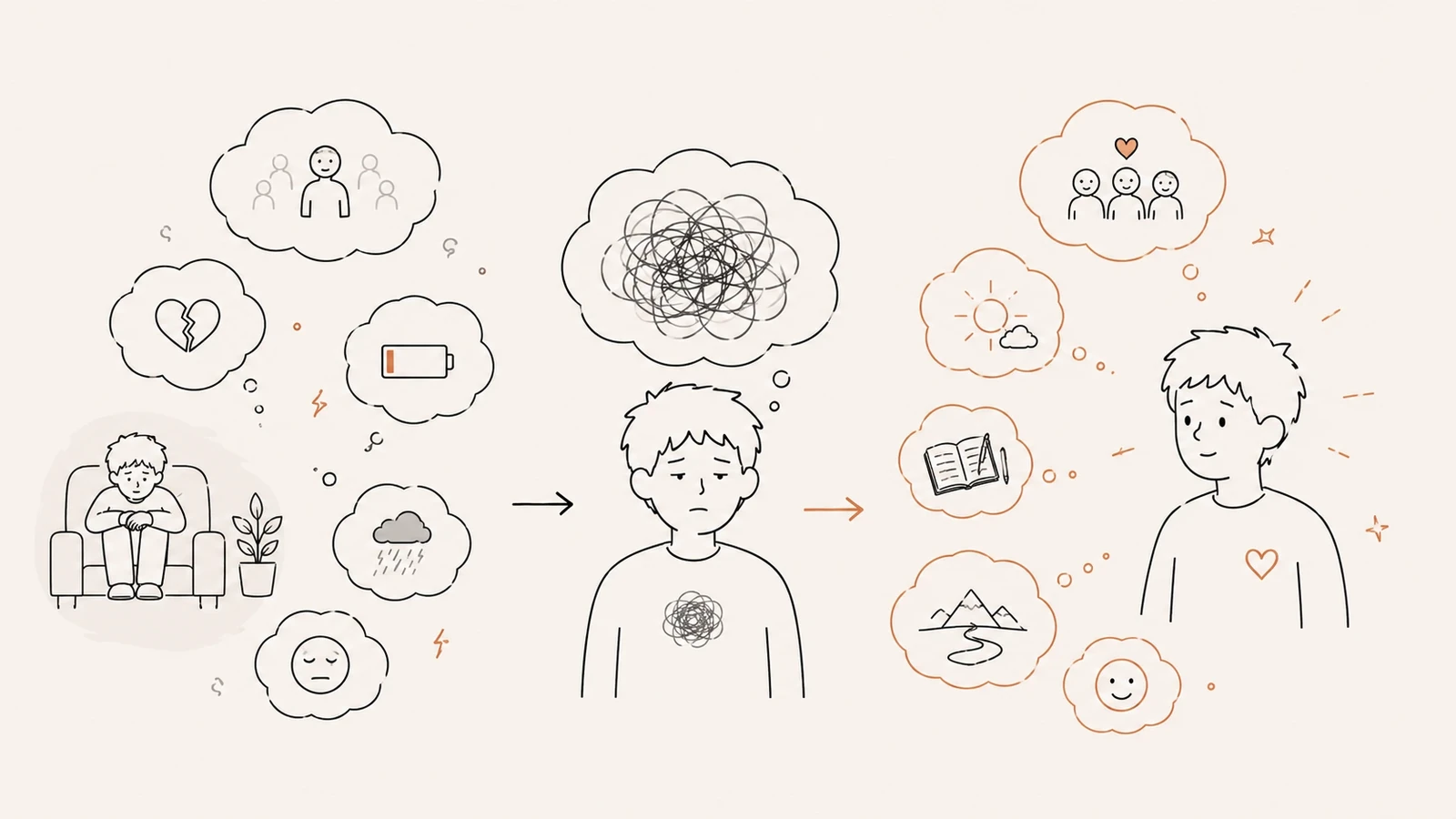
You may not feel exactly sad. You may feel flat, distant, blank, or unable to react to things that would normally reach you. “Emotionally numb” is a useful description of that experience, but it is not a diagnosis and it does not point to one cause. Stress, exhaustion, grief, depression, dissociation, medication, substance use, and physical health can all be part of the picture.
What emotional numbness can feel like
Numbness can mean positive and negative emotions both feel muted. You may go through familiar routines without much interest, struggle to identify what you feel, feel detached from people you care about, or understand intellectually that something matters without feeling the usual response.
A short period of feeling flat after an exhausting or overwhelming event is different from weeks of losing interest, withdrawing from people, or struggling to function. The pattern, duration, and other symptoms matter more than the label alone.
Why it happens: a shutdown that is meant to protect you
The part people find most reassuring is that numbness is usually doing something rather than nothing. When distress runs high for long enough, the response is often not more feeling but less of it, as though the volume has been turned down on everything at once. Clinicians describe this as a protective shutdown, and it is the reason numbness so often follows the hardest stretch rather than arriving during it.
That framing has a practical consequence. If the flatness is a response to load, then the useful question is not how to feel more. It is what is still loading you. Numbness that arrives after months of stress rarely lifts because you tried harder to feel, and it often lifts once the thing underneath it eases.
This is also why the experience overlaps with feeling disconnected. Numbness describes the muting of feeling. Disconnection describes distance from people, from yourself, or from your surroundings. Many people have both, and the difference matters mainly because it changes what you say to a professional.
Possible reasons you feel emotionally numb
Stress, exhaustion, grief, or an overwhelming experience can leave very little room for an emotional response. Some people also experience emotional numbing alongside trauma-related symptoms or dissociation. That may be protective for some people, but it should not be assumed to explain every case.
Depression does not always look like visible sadness. The National Institute of Mental Health lists an empty mood, loss of interest or pleasure, fatigue, withdrawal, sleep or appetite changes, and difficulty concentrating among possible symptoms. Numbness alone does not establish depression.
Medication, substance use, and physical health also matter. A new medication, dose change, alcohol or drug use, hormonal changes, and some medical conditions can affect energy, attention, and emotional response. Do not stop prescribed medication suddenly; discuss changes with the clinician who prescribed it.
Questions that make the pattern clearer
You do not have to diagnose yourself. A few observations can make a conversation with a healthcare professional more useful:
- When did the numbness begin, and was the change sudden or gradual?
- Are all emotions muted, or only certain feelings and situations?
- Have sleep, appetite, concentration, energy, or daily functioning changed?
- Did it follow a loss, prolonged stress, illness, medication change, or substance use?
- Do you also feel detached from yourself, your surroundings, or parts of your memory?
How to come back from emotional numbness
Forcing yourself to produce a large emotion can turn numbness into another performance you feel you are failing. Nothing below is about making yourself feel. It is about removing the load and lowering the bar until feeling has room to return on its own.
Stop grading yourself daily. Checking whether you feel anything yet turns recovery into a test you sit every morning and fail. Pick a date two or three weeks out instead, and decide in advance that if nothing has shifted by then you will talk to someone.
Measure in smaller units than emotions. Comfortable or uncomfortable. More distant or less distant. Heavy or restless. Those observations count even when no clear feeling appears, and they give you something honest to report later.
Act before you feel like acting. Waiting for motivation to return before doing anything keeps you waiting, because with numbness the motivation tends to follow the action rather than precede it. This is the same principle behind behavioural activation in CBT, and it works better than it sounds like it should.
Use the body when the feelings are not available. Eating something, stepping outside, moving gently, holding a warm or cool object, or a sensory grounding exercise all ask nothing emotional of you. Low demand is the point.
Keep one thread to another person. Numbness makes withdrawing easy and reasonable-sounding. Telling one person the simplest true version, “I have felt unusually flat lately,” keeps a door open that is much harder to reopen later.
Look at what might be flattening you. Short sleep, alcohol, and a new medication or dose change can all dull emotional response. Do not stop prescribed medication on your own, but do raise the timing with whoever prescribed it if the two line up.
You do not need to force a feeling to prove that you care. The useful question is whether the numbness is passing, or whether it is becoming a persistent change in how you live.
When it is your partner you feel nothing toward
This is one of the most common versions of the worry, and the first step is working out whether it is actually about them. If friends, work, food, and things you used to enjoy all feel equally flat, the relationship is probably not the cause. Treating it as the cause at that point can do real damage to something that was not broken.
If the flatness really is specific to one person, that is a different conversation and worth having directly. Either way, describing the change lands better than delivering a verdict. “I have felt flat toward everything for a while and I do not think it is about you” gives the other person somewhere to go. “I do not feel anything for you anymore” usually starts an argument neither of you intended. There is more on opening that kind of conversation in how to talk to the people in your life about your mental health.
When to talk to a professional
Speak with a healthcare or licensed mental health professional if the numbness persists, keeps returning, interferes with work or relationships, or arrives with loss of interest, hopelessness, major sleep or appetite changes, memory gaps, or difficulty caring for yourself. A clinician can look at the whole pattern and rule out medication or physical causes.
If you may harm yourself or someone else, cannot stay safe, or believe you are facing an immediate emergency, contact local emergency services now. sokoon is not a crisis service.
Common questions
Can emotional numbness be permanent?
It is not usually permanent. Numbness is a symptom rather than a fixed trait, and for most people it lifts once whatever produced it eases, whether that is exhaustion, grief, a period of prolonged stress, or an untreated condition. What makes it persist is more often the cause going unaddressed than the numbness setting in for good. Long-running numbness is a reason to get assessed, not a reason to assume this is now how you are.
How do you recover from emotional numbness?
Rarely by trying to feel something. What tends to work is lowering the bar on ordinary activity and letting feeling return on its own schedule, rather than treating each day as a test of whether it worked. Protect sleep, keep some contact with people even when you do not feel like it, and get the underlying cause looked at if one is likely. If a medication change lines up with when it started, raise that with whoever prescribed it.
Can dissociation cause emotional numbness?
Yes, emotional numbing is one of the experiences people describe alongside dissociation, often after trauma or during prolonged overwhelm. That does not mean every numb period is dissociation. Feeling detached from yourself, losing time, or having gaps in memory alongside the numbness are the features worth mentioning to a clinician.
Why do I feel emotionally numb toward my partner?
Check whether it is specific to them first. If you feel equally flat toward friends, work, and things you used to enjoy, the relationship is probably not the cause, and treating it as the cause can do real damage to something that was not broken. If the distance really is specific to one person, that is a different conversation and worth having directly rather than waiting for the feeling to return on its own.
Is emotional numbness a sign of depression?
It can be one, but on its own it does not establish anything. The NIMH lists an empty mood and loss of interest or pleasure among possible symptoms of depression, alongside changes to sleep, appetite, energy, and concentration. It is the whole pattern over time that matters, which is why a clinician is better placed to read it than a checklist.
You can start with “I do not know what I feel.”
sokoon offers a free daily text session with no credit card required. Use it to describe the pattern and prepare what you may want to tell someone in your life or a licensed professional.