Can AI Conversations Harm Your Mental Health?
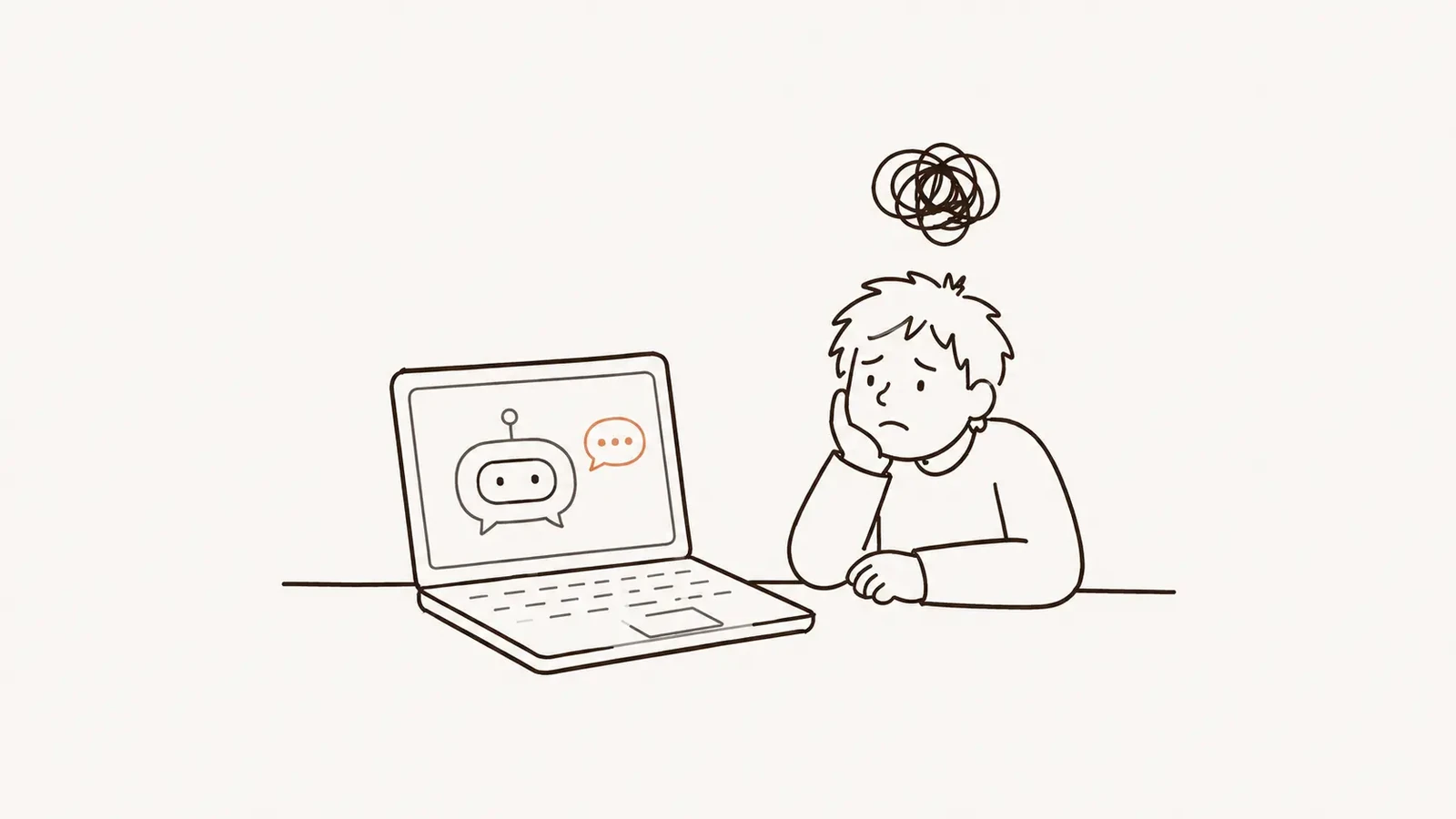
It's a fair question. The honest answer is: some can. Not because AI is inherently dangerous, but because a lot of AI tools have no clinical awareness at all. They're built to keep you talking, which sounds helpful, but keeping someone talking and actually helping them are different things.
What actually goes wrong
If you spend an hour going over the same painful thought with a chatbot that agrees with everything you say, you haven't done therapy. You've rehearsed distress. Cognitive behavioral therapy research on unproductive rumination is fairly consistent: going over something without processing it makes anxiety worse, not better.
The clinical term for this is unproductive repetitive thinking. It's been linked in multiple studies to increased activation of the amygdala, the brain's threat detection region, over time. Going over something repeatedly without resolving it doesn't feel neutral. It trains your nervous system to treat the thought as an ongoing threat. The discomfort doesn't fade. It deepens.
There's also a feedback loop problem. An AI built to keep you engaged will often confirm whatever interpretation you bring to a conversation, even when that interpretation is skewed. Over time, negative patterns become harder to challenge because they've been repeatedly validated. You don't leave those conversations with new insight. You leave more convinced of what you already believed.
The third issue is subtler. When AI makes you feel understood without helping you build any real skills, you become reliant on the conversation itself rather than your own capacity to cope. There's also an isolation problem that goes with this. If your primary source of emotional support is a chatbot, you're less likely to reach out to real people. The research on long-term resilience is clear that genuine human connection, the kind that requires actual vulnerability with another person, does things that a conversation with an AI cannot. A tool that draws you toward it and away from those connections is doing the opposite of what good support should do.
On the psychosis question
This is one of the more serious risks in AI mental health, and it deserves an honest answer rather than a reassuring one.
General AI that constantly validates and agrees with whatever you say can absolutely contribute to psychosis. The mechanism is not subtle. If someone is developing grandiose or delusional thinking and an AI responds with "that's fascinating, you might really be onto something," it does not just fail to help. It actively reinforces the delusion. The person walks away more convinced of something that is not real, having just had their belief confirmed by something that felt authoritative.
Multiple studies have examined how AI validation affects belief formation, and the findings are consistent. Repeated affirmation of false or distorted beliefs strengthens them. For someone who is already vulnerable, whether due to underlying mental health conditions, sleep deprivation, extreme stress, or early symptoms of psychosis, an AI that keeps agreeing with them is not a neutral presence. It is accelerating something that needs to be slowed down.
The pattern tends to follow a specific shape. Someone shares an unusual belief. The AI affirms it. They share a more extreme version. The AI affirms that too. The feedback loop between the person and the AI makes each iteration feel more real and more confirmed. This is not a fringe concern. It is one of the most documented risks in the clinical literature on AI and mental health.
Isolation compounds it. If someone's primary source of feedback about reality is an AI that agrees with everything, they lose access to the honest pushback that human relationships provide. Real people notice when something is off. They ask questions. They express concern. A yes-man AI does none of that, and the absence of that friction is itself harmful.
An AI that only validates is not a safe option. For someone on the edge of a psychotic break, it can be the thing that tips them over.
This is exactly why building an AI mental health tool without clinical oversight is irresponsible. Not because AI is dangerous by nature, but because without clinical guardrails, it cannot distinguish between a thought that needs gentle exploration and a belief that needs to be questioned directly and redirected toward real support.
What to ask before trusting any AI mental health tool
Before using any AI for emotional support, there are a few things worth knowing.
Is it informed by evidence-based approaches, or just general conversational AI? "We use AI to support your mental health" and "we are informed by approaches including CBT and DBT, with input from a qualified professional" are very different claims. The first tells you nothing. The second has substance behind it.
Was any clinical professional involved in the design, not just the marketing? There's a difference between having a therapist write a blog post for your website and having a psychologist involved in shaping how your AI actually responds to people in distress. Ask which one it is.
Does it have a clear protocol for crisis situations? Any responsible tool should have a defined answer to "what happens when someone says they want to hurt themselves." If that answer isn't clear, that's a problem.
Is it transparent about what it is? A tool that presents itself as a replacement for therapy is either dishonest or dangerously overconfident. Good tools are clear about their limits.
Two of those questions have their own answers worth reading before you commit to anything. What happens to what you type is covered in is AI therapy private, including how to check a policy yourself rather than taking the marketing at its word. And the rules changed recently: several US states now restrict what these tools are allowed to call themselves, which we cover in is AI therapy legal.
If you want the longer checklist, we wrote a full guide to AI for mental health — what it is, what it can and can't do, and what to look for before trusting one.
What sokoon does about it
The characters are designed to notice distorted thinking and help you examine it, not agree with it. The pushback is gentle, but it's there. The characters are informed by CBT, DBT, Compassionate Support, and Action-Oriented approaches, which are structured around helping you process emotions rather than loop through them. The goal is always to move something, not just hold it.
When things move toward crisis, sokoon directs users to 988 in the US, or local emergency services elsewhere. sokoon isn't a crisis service and doesn't pretend to be. Real emergencies need real people.
The position on professional therapy is honest too. sokoon is a complement, not a replacement. If something serious is going on, a licensed therapist is the right answer. That's not legal copy at the bottom of the page. It's what the people who built this actually believe, and it shapes the decisions made at every stage of the product.
Try an AI built to actually help you think more clearly.
Experience our free daily text session with no credit card required.